Every client network, documented the same way.
For IT service companies running many clients: each one its own organization, each site kept current by a scanner on it, and the client's own people let in only as far as you choose.
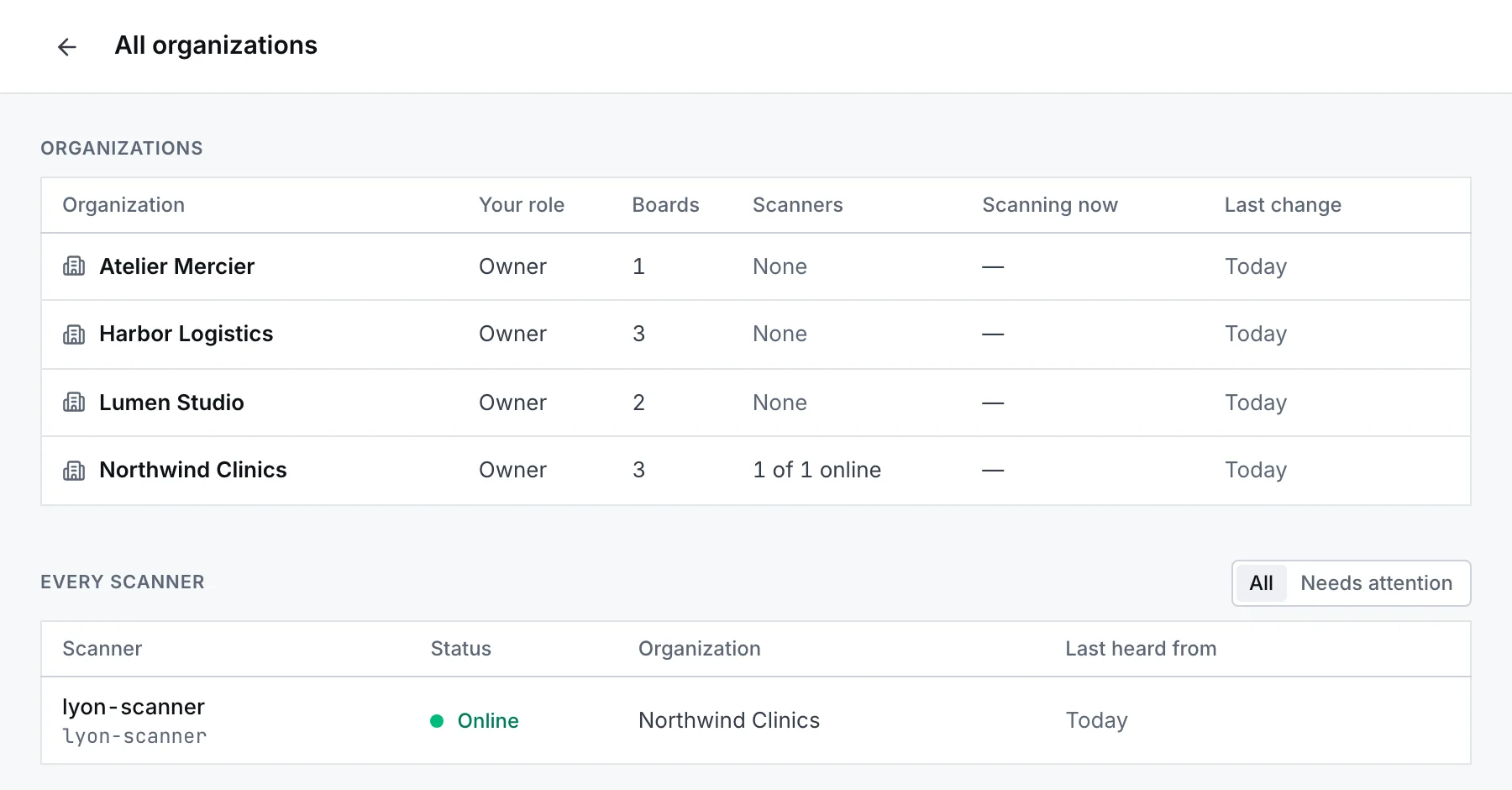
One organization per client.
Each client gets its own space: boards, scanners, members, teams, keys and security policy. Nothing from one client ever appears in another’s lists.
- Switch, never mix
- You are in one client at a time. Switching changes every list and section at once; a link you send names the client it is about.
- One view across all of them
- Every client with your role, their boards, their scanners by status, sweeps running now and the last change — and every scanner in one list, filtered to the ones that need attention.
- Their policy, per client
- One client requires single sign-on, another an authenticator app, a third only its office address range. Each policy closes that client’s data to a session that does not meet it, and only that client’s.
Sites as folders.
Inside a client, folders hold its sites, its environments, its projects — up to four deep.
- Restricted folders
- Close a folder to everyone the organization would let in: the board for the finance VLAN, the incident in progress. Only the people listed and the client’s admins keep access.
- Templates per kind of site
- Office network, server room, site-to-site VPN, segmented network: start every site from the same structure, so every client’s boards read alike.
- Moves that respect access
- Move a board or a folder within the client; crossing a restriction takes the right to manage it, not just to edit.
A scanner on every site.
Put the agent on one machine per client site. It connects out, so there is no port to open in the client’s firewall.
- Driven from your desk
- Start or stop a sweep, change the range and the schedule, pause it or remove it — without a VPN into the client or a shell on the machine.
- Keys that cannot wander
- Each key works for the first agent that uses it and no other, expires, and is revoked when its agent is removed.
- Every command on the record
- Who started which sweep, who changed what a scanner sweeps, and who paused it — in the client’s audit trail.
Bring the client in, as far as you choose.
The client’s own IT can read, comment on or edit exactly what you share with them, and nothing else.
- Grants with an end
- A board or a folder for a person, a team or everyone in the organization — with an expiry, and with or without the right to run its scanner.
- Links for the auditor
- A read-only link with an expiry, a use limit, a password and the only email domains allowed to open it.
- Reports from the board
- Export a board as a numbered Markdown document, a PNG or an SVG, or registers as CSV — the IP plan, flows, services and lifecycle dates.
- When the contract ends
- Export the whole client organization as one file. Deleting it is an owner’s decision, with 30 days to change their mind.
Start with one client.
Create an organization for them, put the agent on one machine at their site, and add the next client when the first one reads the way you want. Every feature is free during the beta.